The ‘One Size Fits All’ Myth of CPQ Solutions
How to Improve Customer Experience with CPQ

I recently went shopping for new window blinds and was surprised to discover the company relied on a thick paper catalog for its sales process. Given the complexity involved in choosing blinds, including fabric, opacity, color, size, material, and room conditions, it was puzzling that they had not adopted a more modern, guided configuration system to improve customer experience.
A product like blinds is a perfect example of where CPQ should help, yet even the strongest standard CPQ tools often fall short. Off-the-shelf CPQ platforms position themselves as one size fits all, but complex products frequently require additional customization to become truly intuitive and reliable.
Blinds offer a good illustration of the challenge. Even before measurements are taken, product options multiply quickly:
- Corded, cordless, or motorized
- Light blocking or light filtering
- Vinyl, plastic, metal, or wood
- Roman shades, honeycomb, or bamboo
- Horizontal or vertical designs
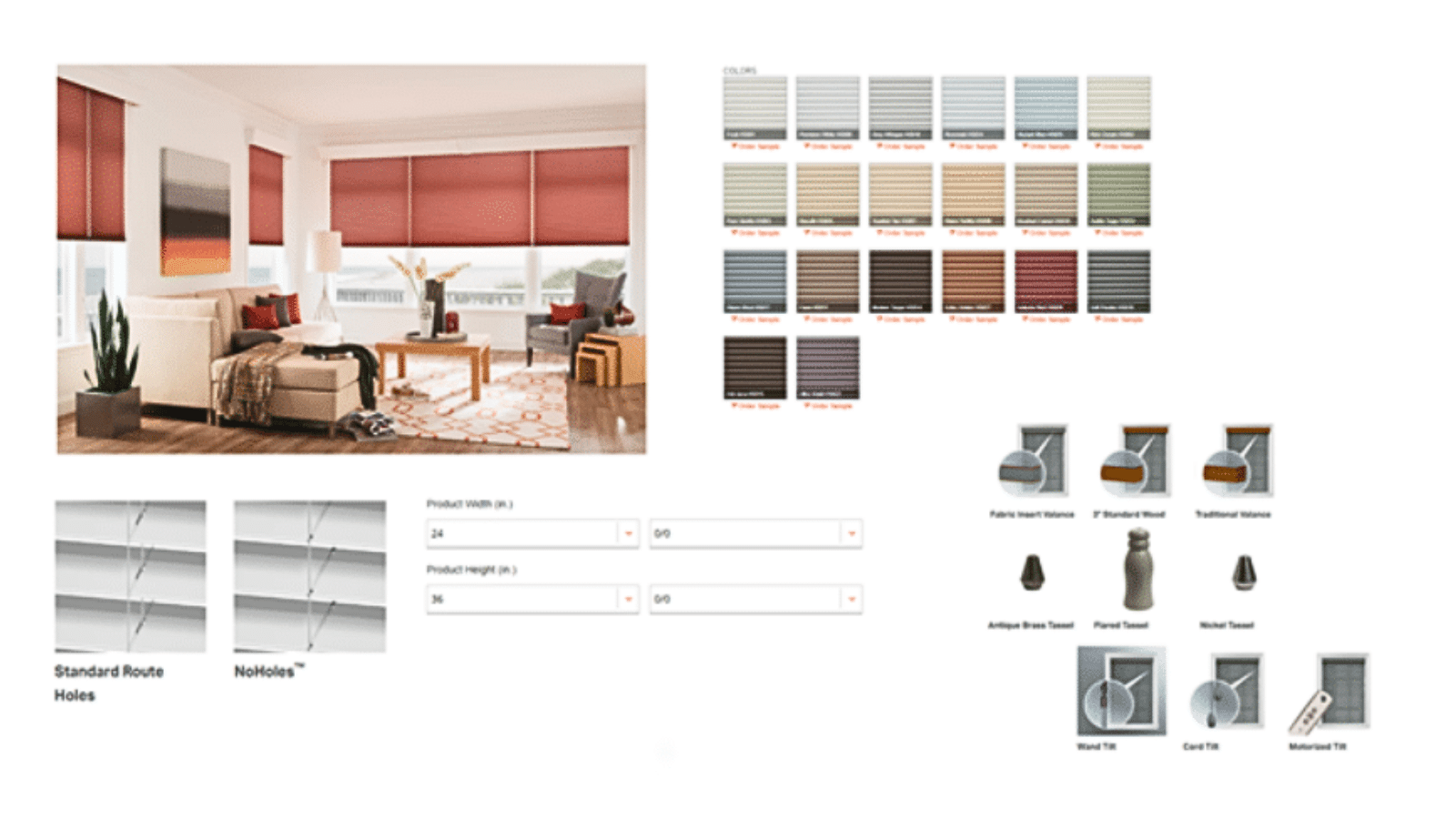
Additional Considerations for Product Configuration
Then there are environmental considerations. Will the blinds be installed in a bathroom with high moisture? A room with strong afternoon sun? A skylight? Each scenario limits which materials and styles are suitable.
A configurator solution easily guides the user to make these choices. It could interpret room details, environmental needs, and customer preferences, then narrow the available options to those that are valid and safe.
Traditional CPQ tools, however, treat each window as an isolated configuration. If a room has five windows and you want to change the color, you would need to update all five configurations manually. This is inefficient and prone to error.
With Configit Ace®, the entire experience could be modeled differently. Concepts such as “room,” “environment,” and “operations on rooms” can be built directly into the application. Changing the color of a room would update all windows in that room at once. Defining a room as a bathroom would automatically filter out configurations unsuitable for heat or humidity.
With Configit Quote®’s offline capability, the customer experience could be even smoother. A salesperson could arrive with an iPad, walk through each room, and configure the blinds together with the customer. Instead of flipping pages in a catalog, the customer could explore valid options instantly. In my case, there were several revisions after the order was placed because invalid combinations had been selected. A guided configurator would have prevented those errors entirely.
This kind of trial and error significantly lengthens the quote-to-order process and increases the risk of losing the sale to a competitor. A smarter configuration approach not only improves customer experience but also protects revenue and accelerates the entire sales cycle.
Precision CPQ for High-Variability Portfolios
Move beyond the “one-size-fits-all” tools and empower your teams with precise, reliable configuration - even with thousands of rules and configuration options.

Henrik Hulgaard is the Vice President, Product Management and co-founder of Configit, a global Configuration Lifecycle Management (CLM) solution provider and a supplier of business-critical software for configuring complex products. He holds a PhD in computer science from the University of Washington and is an associate professor of computer science. He has published more than 25 articles internationally.