Virtual Tabulation®: The Core Technology Behind Trusted Product Data
• Keep configuration data accurate, consistent, scalable, and governed as product complexity grows.
• Enable fast, error-free configuration experiences and deeper insight into what is offered, built, and delivered.
• Provide the deterministic foundation for AI-assisted and agentic product decisions that must be fast, accurate, and valid.

Overview
Virtual Tabulation®: Purpose-Built for Complex Product Configuration
The VT™ Advantage
What is Virtual Tabulation®?
Virtual Tabulation® is the product configuration technology that powers Configit products and helps manufacturers manage complex product data at scale.
Instead of solving complex product configuration logic only at runtime, Virtual Tabulation® compiles all valid product configurations in advance.
This creates a compact, optimized representation of all valid product configurations. It is not a literal list of every possible product combination, but rather a highly efficient, symbolic foundation that can be used to validate configurations, identify conflicts, guide users, and support enterprise-wide configuration decisions.
The result is a trusted data foundation for complex product configuration.
How VT™ Works
The Technical Foundation of Virtual Tabulation®

Virtual Tabulation® transforms a product model, including its variables, values, rules, and constraints, into a precomputed representation of all valid configurations.
Despite the name, Virtual Tabulation® does not create or store a giant database table containing every possible product configuration. Instead, it creates a compact symbolic representation of the valid configuration solution space.
Using techniques such as symbolic representation, Boolean algebra, Binary Decision Diagrams (BDDs), and constraint logic factoring, Virtual Tabulation® can represent extremely large configuration spaces efficiently without storing each valid combination individually.
The compiled solution space is packaged into a compact VT™ package that can be used by applications wherever product configuration is required.
At runtime, applications query the precomputed VT™ package instead of repeatedly solving the full set of product constraints as users make selections.
Virtual Tabulation® transforms an enormous valid solution space into a compact symbolic representation that enables fast, reliable configuration validation.
Core Technology Benefits
Why Virtual Tabulation® Is Different
Most configuration technologies can manage rules, constraints, attributes, and options. The difference is how they perform at enterprise scale.
Virtual Tabulation® stands apart by giving manufacturers a product configuration data foundation that is:
Deterministic
because outcomes are based on a precomputed solution space of only valid product configurations
Fast
because valid product configurations are compiled in advance
Transparent
because teams can better understand, test, and debug product configuration logic
Scalable
because performance is not limited by runtime solving or the complexity of the product model
Reliable
because errors and inconsistencies can be identified before release

Virtual Tabulation®
is a game changer.
Myla Romero, Director of Information Technology,
PLM and Configurator Services, Emerson
Source: Configuration Lifecycle Management Summit 2023
VT™ provides the speed, consistency, and control needed to reduce configuration risk.
It helps eliminate errors, increase efficiency, and provide greater governance of what is offered and what has been delivered.
Trusted by the World’s Leading Manufacturing Companies
Why It Matters
Why Manufacturers Need a Trusted Data Foundation
Virtual Tabulation® created a shared trusted foundation for valid product configuration data.
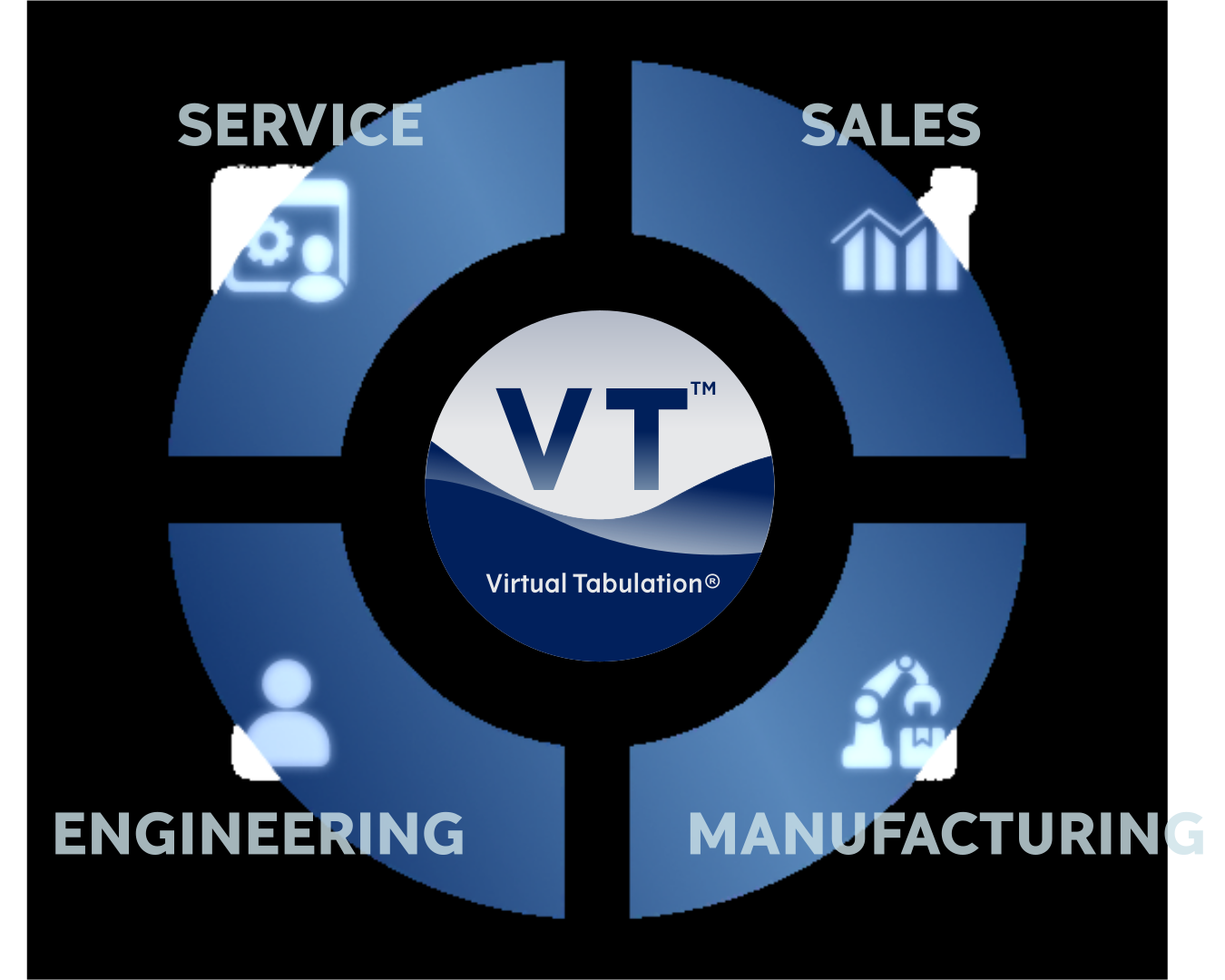
For manufacturers of configurable products, product data is no longer used in one system or by one team:
• Engineering needs to define what is technically possible
• Sales need to know what can be offered
• Manufacturing needs to know what can be built
• Service needs to understand what has been delivered
• IT needs the data foundation to be governed, scalable, and integrated across systems
When product configuration data is fragmented, manufacturers face higher risk of:
• Inconsistent product logic across systems
• Invalid or incomplete configurations
• Slow quoting and order delays
• Manufacturing errors and rework
• Costly debugging and manual validation
• Poor visibility into product options, dependencies, and change impact
Core Enterprise Benefits
Business Outcomes Driven by Virtual Tabulation®
Is this something you want to achieve?
Enterprise Value
How VT™ Creates Value
Across Every Function
Built for Complexity
Built for the Complexity of Modern Manufacturing
Virtual Tabulation® is especially valuable for manufacturers managing:
• Highly customizable products
• Thousands of product options, features, and dependencies
• Complex engineering and commercial rules
• Regional, regulatory, or market-specific requirements
• Shared platforms, modules, and components
• Frequent product updates and engineering changes
• CPQ, PLM, ERP, manufacturing, and service integrations
Product configuration is not just a sales activity. It is an enterprise-wide data challenge.
Virtual Tabulation® transforms that complexity into a trusted data foundation for better decisions and better execution.

Whitepaper
Virtual Tabulation®, Rules and Constraints
A guide to understanding product configuration technologies
By Role
Value Across the Enterprise
Virtual Tabulation® creates value across the enterprise by giving each function a shared foundation for trusted product configuration data.
From IT and engineering to product management and configuration teams, it helps improve alignment, governance, efficiency, and execution across the product lifecycle.
Improve efficiency, eliminate product configuration errors, and accelerate delivery with a governed data foundation. Gain reliable insight into what you offer, what you can deliver, and what customers have already received, helping increase customer satisfaction.
Break down organizational silos by connecting data, systems, and processes. Enable greater automation, collaboration, and governance across the product lifecycle.
Maintain engineering intent across sales, manufacturing, and service processes, reduce data misalignment, product configuration errors, and the need for engineering teams to resolve downstream issues.
Gain better visibility into product options, dependencies, and change impact to help teams manage portfolio complexity and bring configurable products to market faster.
Build configuration logic with confidence, knowing changes can be analyzed and validated before release. Virtual Tabulation® compilation identifies errors and provides guidance to resolve them, while making it easier to understand the impact of changes before they are applied.